Monday, October 13, 2008

Pangu Reprise

Drinking Tea with Nanchang Cops, or Espionage for Retards

I went back to China for a 10-day trip to pick up the trail of Pangu's legacy. In Beijing, the trail was mostly cold, and the stay too short to uncover a lot of genuine emotion beyond the fact that most kids don't really know who the band is anymore or know enough to not say anything. It seems the government's tactic of delete and censor has erased most memory of the band, at least in the pop consciousness. But in terms of a deeper memory, a realm of whispers that silently remembers jailed lawyers, displaced villagers, Tienanmen Square and other denied truths, the band is very much alive and imagined mainly as an earlier version of themselves, the one that was credible and raw, not the current status of extremists exiled for a highly unpopular cause. If they weren't remembered, we wouldn't have been "invited" to "drink tea" with the cops of Nanchang for an hour and 40 minutes.

But that was a mistake in judgment on our part too. Pangu is from Nanchang, a provincial city of 2 million a six-hour train ride southwest and inland from Shanghai. The city is famous as the site where the first shot of the Mao's Communist insurgency was fired, and then after Mao died, it became a minor industrial center for its state-run auto factory. Nanchang's central square still boasts a hulking stone monument to the "Aug. 1 Insurgency," a thick column topped by a stone CCP flag. The irony of the monument is just that of Mao's China; the symbol is supposed to soar but instead looks more likely to sink to the bottom of the ocean for its unwieldy weight. It was on the stone steps of this monument that Ao Bo used to sit with his rock 'n roll buddies and dream of destroying these symbols and what they stood for, namely the Communist Party's rule of China.

In August when I spoke to Ao Bo in Taiwan, he got excited about the possibility of our going to see his father, who lives in a miniature cop village next to a prison in New County (Xinjian Xian), across the Aug. 1 Bridge from Nanchang City. The idea came to him as a spark, then ignited in his mind. "If you went, that would be - wow! That would be something!" In emails since, however, he progressively began to dismiss the idea. He hadn't spoken with his father in a year, and convincing him would be a problem. Later, the day after our tea party, he called from Sweden, berating me, "Not just anyone can walk in there! If you wanted to talk to him, you should have set up a meeting outside."

But CC and LL, our local contacts, were also curious. They'd never seen the man, and Ao Bo is the type of figure that makes one wonder what could have caused a person to become like, as LL said, "always supporting some political position or other, but in that, you never got a sense of his own personal self."

So we went on a whim and a chance, and it just happened to be the last Sunday of the National Day holiday, and the community's guard was down. We found the senior Ao, a spitting resemblance, and he was willing to speak with us. What he expressed was a gruff prison-official-of-a-father's love for his intransigent and rebellious son. And we got it on tape.

At the end, we asked the senior Ao if he had pictures of Ao Bo as a boy. He said he might, but he'd have to rummage around. He'd be in touch with LL if he found anything. Then that night, he called LL, saying he'd found some artwork and notes, things we might want to take. We should meet him back at the cop village the next day at 4pm.

We arrived at 3pm, and within five seconds of stopping the car, a uniformed cop had us pegged. LL's ID was taken and we were instructed to drive back to the end of the block, where there was a precinct station. They took LL's car keys and then our passports and brought us in for questioning.

The first cop was egregiously smiley, laughing constantly in phony way and inviting us repeatedly to drink tea and smoke Jiangxi's local cigarettes. We took hot water. I excused myself to the bathroom and called a friend, telling him I was in a police station and would call back in a couple of hours if everything was ok.

The cop, Smiley, asked us our names, place of residence, occupations, and how I had come to speak Chinese so well. And what we were doing there. I told the half truth that I had met Ao Bo at a rock concert in Taiwan and kept in touch through email. When I told Ao Bo I'd be traveling through China, he'd asked me to pick up a few things from his father.

After a few minutes of this, a second, sterner uniformed cop came in, Bad Cop. He had a hard jaw, a louder, deeper voice and slicked back hair. He asked us the same questions, and we gave the same answers. He told us that Ao Bo was a serious matter. That's about as much as they ever told us about Ao Bo, though through opportune mentions of "Taiwan" and a few other things, it was obvious they knew a lot more.

Different cops kept shuffling in and out of the room, but whoever was asking the questions, they were always the same. We were offered more hot water and smokes. Some plain-clothed cops appeared and were introduced by Smiley as being from "our travel agency." The euphemism was so ridiculous I didn't even bother to ask what it meant. I guessed they were the National Security Bureau, though that may have been wrong. The next day, LL was to meet with National Security Bureau agents for questioning. So who the hell were these guys? They all had buzz cuts, wore slacks, dark gangster shirts and bad leather shoes. Two of them were young; they never spoke and unsubtly perked up their heads the couple of times we spoke English. The senior plain-clothes asked us the same questions as the others. We gave the same answers.

One thing they never asked though was why we'd been filming, and this worried us, and not just then, but all of that night as we rode an overnight train in hard sleeper berths to Guangzhou. During the interview a day before, Ao Bo's father had called me a "journalist," and at one point I'd told him I was making a documentary. This was potentially damning. My partner P, in China with the special pseudo-passport that China gives to Taiwanese citizens, was mulling the fact that China has imprisoned tens of thousands of Taiwanese accused of spying. I was even more worried for LL, who had a wife, kid and a government job to lose. As a Western national, the worst that could happen to myself was a few days of detention and expulsion from China. I kept telling myself, fuckit, these are cops, and played dumb, repeated the same story and tried to crack the odd joke.

Somewhere in the middle of all this, P heard one cop say that he wanted to bring in Old Ao. But another said, "No, they're not finished talking to him yet." The father was being questioned somewhere else at the same time, and I think he must have been putting up a smoke screen, possibly for himself, possibly for us, possibly for his son. I'll probably never be sure. But the cops did repeatedly say that Old Ao was "one of our own" and that they had to "take charge" of him and "protect" him.

About an hour into the tea party, we told the cops we had a train to catch, and we showed them the tickets to Guangzhou. They told us not to worry about it and offered to drive us to the train station in a police car. "In America, if you ride in a police car, it is only because you are a criminal," joked Smiley. "But in China, that's not necessarily the case."

Our excuse to get out of this was our wish to have a final dinner with our friend, LL. Also, we had no desire to give the cops even the faintest idea of how much camera equipment we were carrying by putting our luggage in one of their cruisers.

When we opted out of the royal escort, Bad Cop just shrugged and said fine. I got the feeling it would save him some trouble. Our passports were handed back, and LL got his ID and car keys. Smiley waved and said it wasn't a big deal and he hoped he hadn't inconvenienced us. I was about to get in the car, but after thinking about it for a sec, turned back to him and said, "Look, I want to ask you something. There's still one thing I don't understand, and that's why Ao Bo is so sensitive. I don't really know this guy, and now I'm wondering if I should call him up and tell him he's an asshole for sending me here and getting me in trouble with you people."

"No, no, no," said smiley. "It's just that...this is a sensitive area. There's a prison here, and outsiders never come in. You're outsiders. Of course we just had to find out who you were. Next time you're in Nanchang, feel free to come back."

As we drove out the gate of the cop-prison village, I assured LL we'd keep his name out of the film. Then in the back seat, P wrote on a piece of paper, "They may be listening." This was all a little surreal, so I did what anyone else who'd only ever seen movies about this kind of thing would do, I kind of smirked to myself and ran my fingers over the dash, around the rearview mirror, opened the glove compartment...

"Would you stop that!" said P from the back seat.

Dinner was grim. We barely ate, just drank beer instead. CC had just gotten off work and finally joined us. Thank god she'd missed it. She said she wasn't worried, even if the cops did come knocking. She'd been through that before and knew they couldn't touch her. LL also assured us he'd be fine, but I had no idea if he could possibly mean that.

On the train, P and I had a comically paranoid conversation, a long, drawn-out "What would Jason Bourne do?" bull session. I saw two alternatives. One, hide ourselves in a safe house in Shenzhen, have one person cross the border carrying nothing, and if he made it, call back to the other to give the all clear.

"Dude," said P, "That's how drug smugglers get caught." He was convinced they were setting us up, that they'd let us keep going to see what we'd do and who else we could implicate. "You don't know how the Communist Party works! This is the let-a-thousand-flowers-bloom shit!"

The cops' conspicuously blind eye to our filming activities was the unnerving question that kept stabbing back at us. I bemusedly proposed an Occam's razor solution, "Look, since they have to write a report to save themselves from getting in trouble if anything happens later, maybe they are just happy enough to play along with our bullshit story because like most cops everywhere, they are lazy and just want a plausible answer that will save them from any extra work."

P was having none of that. Every other guy on the train had a buzz cut and bad leather shoes, and even though we had bought our tickets through a scalper and without showing any ID, he was lining up suspected shadows.

"Well, how about at the next stop I'll grab my backpack and hide in the bathroom, and we'll see if secret agent Larry does anything," I said.

At least that lightened things up.

"Yeah, what would Jason Bourne do?"

God! he was thinking it too!

In the end, P chose option two - get the hell out. We arrived at Guangzhou East Station around 8am, and he left me with the camera and tripod, took the tapes and bought a train ticket to Hong Kong. I was fine with this. He had the most to lose.

P made it through customs in Guangzhou before 8:30am, too early for whatever the hell it was we were scared of. We'd figured that since the cops let us go around 4:40pm the day before and still had someone to question today, they may not have filed any reports before getting off and we wouldn't be flagged yet. I now doubt we ever were flagged, or else the process was so slow we won't find out till next time.

I headed for a safe house in Shenzhen. Actually, it was a friends apartment I had keys to, but calling it a safe house was really feeding into my whole spy fantasy thing. Now that I look back on things, that whole 24 hours was like the Bourne Conspiracy for retards. It was like, 'Geez, I may be a national security threat for my little videography project, so I'll just hop a train to Shenzhen, switch SIM cards, then go check my email in Starbucks.'

Which is exactly what I did. When I called P that afternoon, he'd just gotten off a plane from Hong Kong and was back in Taipei. "Yeah, there was a little bit of a scare going through customs, but I think it was just a random check." He was fine. I also got an email from LL, who said the meeting with National Security had just been routine, and I hope it in fact was.

Perhaps a bit like Chai Ling, the student leader at Tienanmen Square, I had a lingering hope for a more brutal police display. She had so infamously anticipated - in fact almost awaited - the bloodshed of Tienanmen, saying it was the only way the Chinese people would learn of their government's oppressive nature. Unlike her, I graciously never got my wish. What I got instead was an afternoon of drinking tea with cops and a brick wall sealing out everything people knew about Pangu and would never say in public even if they knew it to be true.

This affected the Nanchang cops and Beijing's rockers alike. The old punks and metalheads I found in Beijing who clearly hated the band wouldn't express anything openly, even anonymously, i.e. with only a voice recording. Talking into a microphone to someone who didn't even know your name was still too public and potentially dangerous for most. My being a stranger and a foreigner I guess had a lot to do with that.

Getting to real feelings may take longer and require less direct questioning, maybe even a different identity. Two and a half years ago, a kid tried to stop me from buying a Pangu CD in a Wudaokou music shop, in no uncertain terms letting me know "Their music sucks!" "They betrayed their country!" "They sold out their country!" This time, the best I could get was some dorky metalhead trying to evade all my questions, but not so slyly saying, "My view on Pangu is consistent with that of the government." That and a Guangzhou music critic saying he thought they were conned by Chen Shui-bian and the DPP, that they were naive and didn't know the deal going in.

What surprised me though was the continuing belief in what Pangu was, an identity the band assumed in person around 1998 and was slowly disseminated throughout China over the next two or three years. I found a steady collection of rockers from Guilin to Shanxi to Xinjiang with a consistent story, namely that when they were 14 or 15 or 17, they suddenly found a band that was telling them the truth through rock and roll. "Before them, I listened to Cui Jian and Zhang Chu and He Yong, and I thought that was great. But then I heard Pangu and realized that everything they were saying was all wrong."

It was not just one kid that made such claims. It was several. And the stories were so often the same.

And it's that memory, of a band that suddenly meant something, which is Pangu's legacy in China. The egregiously political entity they have become since then, for worse in the eyes of most who still even remember them, seems not to be the important thing. It is the whispered legacy of some raw punks from Nanchang who screamed out "You won't let us rock!", who lampooned Cui Jian and the whole Beijing scene, and who intimated that kids had a right to want something better. That's what remains. And that's what's buried behind a wall of official silence, not forgotten, and waiting for its story to be retold.

Thursday, July 27, 2006

More on Death Metal and the DPP

Freddy: "I'm not deep green, I'm pro-independence!"

The lead singer of Taiwan's best loved black metal band and concert empresario Freddy is in the political columns again. Actually, let me just translate this, from Formosa TV:

On the petition brought out by scholars to recall President Chen, one
English name was included - Freddy. Local media has indicated that this is the
Chen supporting lead singer of the band Chthonic, but on July 26
Freddy personally came out to clarify the situation, saying that the name
on the Internet petition was not his, that he doesn't want to get caught up
in political battles, and that he supports Chen as president until his
term runs out in 2008.

The web petition set up by the scholars was intended to use
"democracy" to "fulfill Taiwanese identity," and Freddy's name appeared there on
July 16. Media immediately reacted by thinking the Chthonic lead singer had
turned against Chen before Freddy came out and personally clarified that the
name was not his.

Freddy emphasized that he was a die-hard supporter of Taiwanese
independence who had voted for Chen in the last two presidential elections. His
recent call to "reform justice," he said, was meant to indicate that both the
blue and green camps have made mistakes, but he continues to support Chen as
head of the government.

Freddy said he is now busy promoting his band Chthonic's 10th anniversary
CD release and also with this weekend's Formoz Festival, so how would he have
time to get mixed up in the blue-green political battle?

Another article someone sent me had Freddy talking more about politics, saying, among other things, that there is a difference between the "greens" and supporters of Taiwanese independence, that difference being that "greens" belong to political parties while he doesn't.

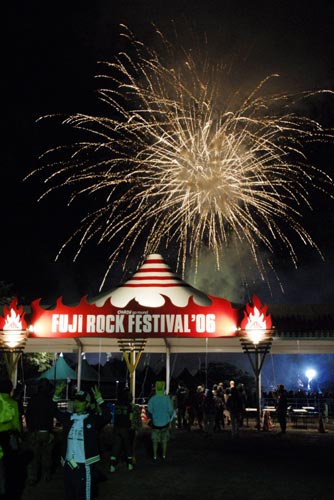
Blogging at Fujirock

The 10th Fujirock Festival is underway as of a couple of hours ago now, and I will again be blogging about it for Fujirockers.org, a festival adjunct. Note I don`t link to the site....This year the e-team has set up a blog for show reports, news, and other hopefully qualified observations culled from the rather less penetrable Fujirock Express site, where content will also go if you want to wade through 70 percent Japanese and pulldown menus that hide most of the articles. Feel free to compare for yourself.

Of minor interest, Fujirock Express becomes a daily newspaper this year (Japanese only) distributed (free? still don`t know) throughout the Naeba Valley. Just another trick they`ve learned from Glastonbury.

Saturday, July 22, 2006

Hmmm. Should I bother to read this?

There's a new book on Taiwan out by Joshua Samuel Brown, you know, of 'Off the Rails' column in the China Post fame. The title, Vignettes of Taiwan, does not make me want to rush out and get a copy... though it did get a decent review from the Shanghai free monthly, City Weekend, where Brown is now a contributor. But for some reason I doubt this will be as good as John Ross' Formosan Odyssey, which is probably a bit underrated and managed to tell us a few things about the island we didn't already know.

Thursday, July 20, 2006

Chinese Rockers Play Taiwan for the First Time Ever

And Cui Jian gets axed from the lineup

Could Formosa TV have screwed up a concert any more royally? Cui Jian (崔建), the king daddy founding godfather ultimate dudeman of Chinese rock 'n roll, had applied three straight years to play the Hohaiyan Music Festival in Taiwan, and this year for the first time by some fluke or brain spasm or act of God finally got approval from Beijing authorities and was ready to come. This was to be a historic first, a landmark in cross-strait music, the first ever Chinese rock bands to play Taiwan.

So what happens? FTV axes Cui from the lineup because instead they want Black Panther and Tang Dynasty, two legendary China bands to be sure, but they are not Cui Jian. If the essence of Chinese rock 'n roll can be distilled to a single man, that man is Cui.

Two Japanese bands, Dragon Ash and 雅 (sorry, no English name at present), were also cut from the bill at the last minute, and some people were pretty pissed off by this.

At least this is what I heard from a longtime Beijing rock scene insider with solid connections to all of Taiwan's music festivals and Japan...

...who told me all this drinking beer outside the Beijing Club D-22, after the 8th band birthday concert for girl punk rockers Hang On The Box, who played for all of 25 minutes. (Great stuff tho.)

Cui Jian, said my can-of-Yanjing-beer-drinking source, wanted to come, but not to FTV's candy-assed pop parade. He wanted to come to the other Hohaiyan put on by Taiwan Colors Music (TCM), a real-deal indie label that founded Hohaiyan 6 years ago and only lost the fest this year through the supposedly "fair" practice of open bidding, which in this case was actually just money politicking. Ronnie Brownlow reported this much in the Taipei Times, but in the end had trouble ironing out the tangle on how the concert was split in two. The bottom line is that TCM got screwed out of the concert it created because the yokel bureaucrats at Taipei County Government controlled all the money and thought they knew better, so in the end TCM decided to do its own concert on the same beach but a week later. Then a typhoon came on FTV's weekend, so they delayed, which of course bumped TCM right off into oblivion. Record label head and visionary behind the whole thing, Zhang 43, announced that the TCM Hohaiyan is now delayed to next year.


"Of course a TV station can run a music festival better than a record company" is how I interpolate the idiot thoughts of the Taipei County Culture Bureau, who through Zhang 43 have stumbled on to a way to make a more popular and international version of the Changhua Flower Festival - "Heck, as long as there area sausage vendors, the people will come!"

(Now whether this has anything to do with the DPP losing Taipei County in last year's election to the KMT I'm not sure, though that was predicted by many. Still, FTV is not far removed from being a DPP propaganda arm....)

The Good News: Tang Dynasty (唐朝) and Black Panther (黑豹) play tonight (Friday), which will be historic. These are the first real rock scene bands from China ever to get permission to play Taiwan, something no one thought could happen after the last Taiwan concert by a Chinese group. That of course was by Pangu in Feb. 2004 - they went into exile immediately after the concert.

So everybody go, and tell me about it. Dagnabit. Wish I were there.


Tang Dynasty - Chinese Led Zepplin


Black Panther - when rock was for dudes!

More headlines:
崔健宝岛行告吹 民版海洋音乐祭遭台风搅局停办
(Cui Jian's Jewel Island Trip Cancelled: Hohaiyan Music Festival People's Edition Called Off)
【海洋音乐祭】官版恐因台风遭延期 民版伤脑筋
(Hohaiyan Music Festival: Official Version Delayed By Typhoon; People's Version Scratches It's Head)
海洋音乐祭大和解 角头义助唐朝黑豹工作人员赴台
(Hohaiyan Music Festival Compromise: TCM Helps Crews for Tang Dynasty and Black Panther Get Visas)

Sunday, July 16, 2006

Odd Job Lives!

And he's a lackey of evil foreigners with mustaches


The carnage. Source: Xinhuanet

This story of a two blond, mustachioed foreigners sending their Chinese friend (or interpreter or bodyguard, depending on who you believe) as a samurai punisher on eight young males taunting them in a Beijing restaurant a few days ago and in a flury leaving seven of them on the ground with non-fatal stab woundsand has been more than good enough to wake me from my blogging slumber, especially as there seems to be at least enough truth to it that it was reported in the local press. First here it is in Chinese on Xinhuanet, and then here's a good write-up on the blog the Shanghaiist(English), which also gives an idea of how in only a couple of days this has already become something of an urban myth with all kinds of bizarre permutations. I first heard that it happened in Chengdu and involved diplomats and their hitman - take this with a grain of salt. But what I really wonder was where was this guy in the Pig and Whistle in Hsinchu?

...okay, now I finally feel like I'm back in China.... and to make a quick follow-up on the last post, Gmail works fine here, so does Google, for the moment...


Friday, June 09, 2006

Gmail Also Affected By Ban

I've sent a couple pings into China about the Google.com blackout, and I've heard from one friend that Gmail is also affected:

yeah, it's very annoying. I couldn't use gmail and google just now for about two hrs. It's been like this for the past one week, seriously affecting my work...

While in China earlier this year, I also experienced a one or two-day Google blackout on March 14, which was possibly a test run. Though to be honest, I was finding the Internet so full of twists and turns at that point it's hard to say.

Now I wish I knew what the technology issues were here - are Google and Gmail linked so closely that blocking one blocks the other? ...so I posted the question on this Slashdot thread, and hopefully I'll have some replies...

...coz those friggin cloistered geeks really need something to talk about other than whether or not Google is evil (to the tune of like 500 comments on the two newswire stories that came out last week). There are of course other issues, like:

1) Google is nowhere near China's most popular search engine, lagging significantly behind Baidu for example. I wonder who the Slashdot nerds would rather see win that battle, a compromised Google or some homegrown Chinese search engine? Which brings us to the next point:

2) The Chinese government, or at least the whole zeitgeist it presides over, encourages negative reporting on Google and other suspect Western media/new media companies. Remember, Western colonialism (yes, from the 18th-early 20th centuries) continues to be upheld as a popular myth explaining why the country is so fucked up now. Google has been blamed for holding and improper business license and god knows what else, with the media coming down like pitbulls as the government changes the rules every other day. Now let me restate this question about Google vs. Baidu, but in a different way:

3) Google knows what China is not seeing, and for now it cannot show it, but possibly in the future it may bring this awareness into play in very subtle ways. Baidu may be able to get away with more now but will certainly aim for much less, slowly opening up to information democracy at the pace of China's domestic social/political change, which is happening, though not the rate the international press might desire it. (Note: Compare this to the US government's position that: elections-in-Afganistan-now-will-solve-everything! The point being, immediate change is not always deep change.) Baidu will also be more invested in the national ascendance, with better connections to power for good and for ill. But there is no saying when and how a heavily monitored Google.cn will make China more global. (Tho I bets they got some crafty insane anti-Chinese tech-warfare they gonna drop on they flat-assed commie bi-yatches, boyee!) In Google vs. Baidu, it's hard not to picture it as an us (West) vs. them battle, and here my instinct is to root for the home team, but God only knows what's right or best?

Sunday, June 04, 2006

Taiwan and Tiananmen's 17th Anniversary

At the luncheon following this morning's pan-blue June 4th Forum, the best reason I heard for Taiwan's suddenly renewed interest in commemorating the Tiananmen Square Massacre on this, its 17th anniversary, was Lien Chan's visit to China last year. Lien's quest, softbrained and sychophantic as it may have been, has reawakened the idea that Taiwan might take proactive policies towards the Mainland.

Or at least it reminded the DPP that if the blues are talking about this, the greens had best come up with a line of their own. Which was why yesterday, June 3, saw the DPP holding its first ever commemoration of Tienanmen (Chinese articles 1, 2, 3, 4) and giving their usual, vague lipservice to human rights.

Meanwhile Ma Ying-jeou and the blues (Chinese) had their own commemoration, as Ma and the blues do every year. They talked about absolutely nothing related to human rights, which at first confused me before I whacked myself in the head for being so naive. The KMT take on Tienanmen was actually rather predictable: "Gee, the motherland - er, oh right, 'mainland China' - they're about as screwed up as a country can be, well uh, outside of our official ally states I mean, and golly it might take 100 years or more, but, well heck let's talk about it anyway, how and when are we gonna unify with them again?"

Now just in case you were wondering, don't worry, there's not much popular interest in Taiwan over Tienanmen, not any more. The candlelight vigils of 1989 in Taiwan's parks, schools and public plazas are pretty safely relegated to popular memory - i.e. the Taiwanese have been there, done that, and if you ask them you'll see how they unabashedly ask you back: what's it got to do with us anymore?

"Yes, June 4th is recieving more attention in Taiwan than it has in recent years, and the reasons are mostly political," agreed Fang Yuan (方圓), one of the labor leaders during the Beijing demonstrations of 1989, who afterwards quickly escaped into exile and currently heads the China Labor Party from his home in Australia. This might be a good place to credit him with the idea about Lien Chan's visit reviving Tienanmen in Taiwan as political tool.

As this was a solidly pan-blue forum, pamphlets showing President Chen Shui-bian and his coterie in Nazi SS uniforms were hardly a surprise, nor was the "No Justice, No President" t-shirt of the old and slightly retarded-looking man sitting in front of me. In the open section following the panel, someone proposed a law against "selling out the country," claiming the greens were the greatest source of this imminent danger. Quick aside: after a decade of hanging out with and writing about artists and musicians in Taiwan, I can safely say, if you want to find the real freaks, look to politics.

The old boys I lunched with were all in favor of impeaching both the president and vice president - at the same time! - and one of them, Loh Kao-ming (樂可銘), the chairman of some blue splinter party I'd never heard of (the New People's Party? - 新民黨), had taken out a half-page newspaper ad full of constitutional convolutions that would bring this long fantasized blue coup d'etat to life. All dining concurred that Lien Chan should remain KMT Chairman, and at any mention of Chiang Ching-kuo, their faces washed over with a warm, nostalgic dew.

Loh told a story about an encounter with Ma Ying-jeou: "He was surrounded by reporters, but when they cleared out a bit, he recognized me and I stepped in to shake his hand. As I was shaking it, I told him, 'I have no problem with you becoming the next president, but I cannot support you taking the KMT Chairmanship from Lien Chan.' At that, Ma recoiled as if in horror and tried to pull his hand away, but I grabbed it with both hands and kept talking..."

...Three luncheon-mates had been sentenced to jail, two actually serving it. Loh once got three months as the butt end of some political revenge intrigue, but he'd paid his way out of actually serving time for a little over NT$80,000.

There was Yan Peng, a Chinese political dissident in passport-less limbo, a 1989 era demonstration leader who listened silently as Loh bombastically rattled on, "At Tiananmen, what else could the Chinese government do? During Vietnam, America shot college students too!" He waited humbly through the dinner, until one of the old boys' wives asked where he was from, followed by, "Oh, what are you doing here?"

"Seeking political asylum."

After two years and some months in Taiwan, the first 9 of those months in jail, Taiwan won't take him for lack of a political asylum law and has only been able to arrange political asylum with Honduras.

"Honduras! That would be a living hell!" chuckled one old boys. He had connections to the military.

Yan thought so too and had refused.

"Don't worry, you did the right thing. If you need any help, just ask us." And they handed him name cards and spun the lazy susan.

The third political was a worn-down Taiwanese woman in her early 30s with a blue wrist - some medicinal unguent, she said. She'd spent a month in Chinese jail after going into both the French and American embassies in Beijing seeking political asylum - from Taiwan! She claimed to be the victim of political oppression from the current government, which oppresses her by invisible means, preventing her from getting or keeping any sort of job. This having something to do with the daily reports she sent to President Chen by email of fax from 1999-2001. It was some sort of policy analysis. She was serious, and seemingly rational, for someone with a story that was completely insane.

Okay, now the disturbing thing is this. What brings this whacky fold back into the zone of political reality is that, Chinese dissidents possibly excepted, these are the faithful. These are the died-in-the-wool partisans who must routinely be placated. While Ma Ying-jeou struggles to pull the KMT out of the tar pits of its tainted past, his milieu is symposia and banquets like this, and each has its own Loh Kao-ming, mitts tenatiously clasped and trying to pull him back down.


End note: A quick list of Chinese dissidents in attendance:

Shao Jiang (邵江), Tiananmen student activist. Panelist.
Wang Min (汪岷), secretary general of the China Democratic Party, Oversease Section. Panelist. Quote: "June 4th is our moral advantage over China."
Fang Yuan (方圓), Tiananmen demonstrations labor leader and current Chairman of the China Labor Party. Quoted above.
Wu'er Kaixi (吾爾開希) - Tienanmen student leader and resident of Taiwan. Uncharacteristically, he did not speak.
Yan Peng (燕鵬), the above mentioned, passportless dissident. Also a Tienanmen-era activist from Shandong Province.